
Once You've Decided What Something Means, Your Brain Gets Very Good at Finding Evidence!
Have you ever decided that someone doesn't like you?
Once you've made that decision, something strange happens.
You start noticing everything that proves you right.
They didn't say hello.
Evidence.
They didn't invite you for lunch.
Evidence.
They disagreed with you in a meeting.
More evidence.
They walked past without looking at you.
Definitely evidence.
But what about the times they did say hello?
The time they asked how you were going?
The time they helped you?
Your brain might barely register those.
This isn't because you're stupid.
It's because our brains are very good at looking for information that fits the story we've already created.
If you believe:
"Management doesn't care about us,"
you'll notice every decision that supports that belief.
If you believe:
"I'm no good at this,"
you'll notice every mistake.
If you believe:
"Nobody understands me,"
you'll notice every time someone gets it wrong.
And gradually the belief becomes stronger.
The tricky part is that it can feel like you're simply looking at the facts.
You're not necessarily lying to yourself.
You're just looking through a particular lens or filter.
This happens in relationships, workplaces and families.
It can even happen with ourselves.
So here's a useful question:
"What evidence am I ignoring?" (asking this question requires practice)
Not:
"How can I prove myself wrong?"
Just:
"What else is happening here?"
If you think your boss doesn't respect you, what evidence supports that?
And what evidence doesn't?
If you think you're failing, what have you actually done well?
If you think nobody cares, who has actually shown that they do?
You don't have to replace a negative belief with a positive one. This isn’t a game of playing the optimist.
You just need to make sure the belief you're carrying is based on the whole picture.
Because sometimes the problem isn't that the story in your head is completely false.
It's that it's only part of the story. It's only gathered the fast, efficient evidence, not all of it!
Remember, your brain is calculating meaning at incredibly fast rates. It's up to us to discern whether the whole picture supports the actual truth of what is happening.
Be careful about collecting evidence for a conclusion you've already made; test it!
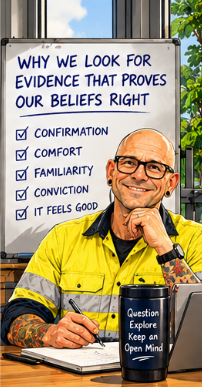
Our brains can favour information that supports what we already believe. Learning to question those beliefs can help us see the bigger picture.
