
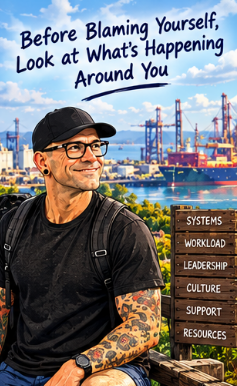
Before blaming yourself for struggling, consider the pressures, circumstances and environment influencing how you're feeling.
When someone isn't coping, our first instinct can be to look at the person.
What's wrong with them?
Why aren't they handling it?
Why are they so angry?
Why are they withdrawing?
Why aren't they performing?
Sometimes that's a reasonable question.
But it isn't always the most useful one.
Sometimes we need to look at the environment.
Think about a plant.
If it's struggling, you don't immediately blame the plant.
You look at what's around it.
Does it have enough light?
Too much water?
Not enough water?
Is the soil poor?
Are the roots damaged?
Is the temperature wrong?
The same principle can apply to people.
A worker who is exhausted might not be lazy.
They might be working twelve-hour shifts, sleeping badly and carrying problems at home.
Someone who has become short-tempered might not suddenly have become an arsehole.
They might have been under pressure for six months.
Someone who has withdrawn might not have stopped caring.
They might have nothing left in the tank.
This doesn't mean we remove personal responsibility.
People still have responsibility for how they behave, and need to be accountable for that!
But understanding the conditions around someone can help us understand the behaviour, and why it's happening- again, not excusing, just understanding.
A person doesn't exist separately from their environment.
Workload matters.
Sleep matters.
Relationships matter.
Leadership matters.
Conflict matters.
Money matters.
Family matters.
Fatigue matters.
Uncertainty matters.
So when someone isn't travelling well, instead of only asking:
"What's wrong with them?"
try asking:
"What's happening around them?"
Sometimes the problem is inside the person.
Sometimes it's outside them.
Often it's both.
And sometimes the most useful intervention isn't changing the person.
It's understanding the conditions they're trying to operate in, and helping change them!
Before you blame the plant, check the soil.
In Social work, we look through this systems lens to see all the influences that affect humans and their behaviours; we don’t just focus on the person. We consider how all those moving parts are interacting to sustain the current behaviour, and as we make changes in those moving parts, it creates space for the behaviours to change…. Funny that!
