
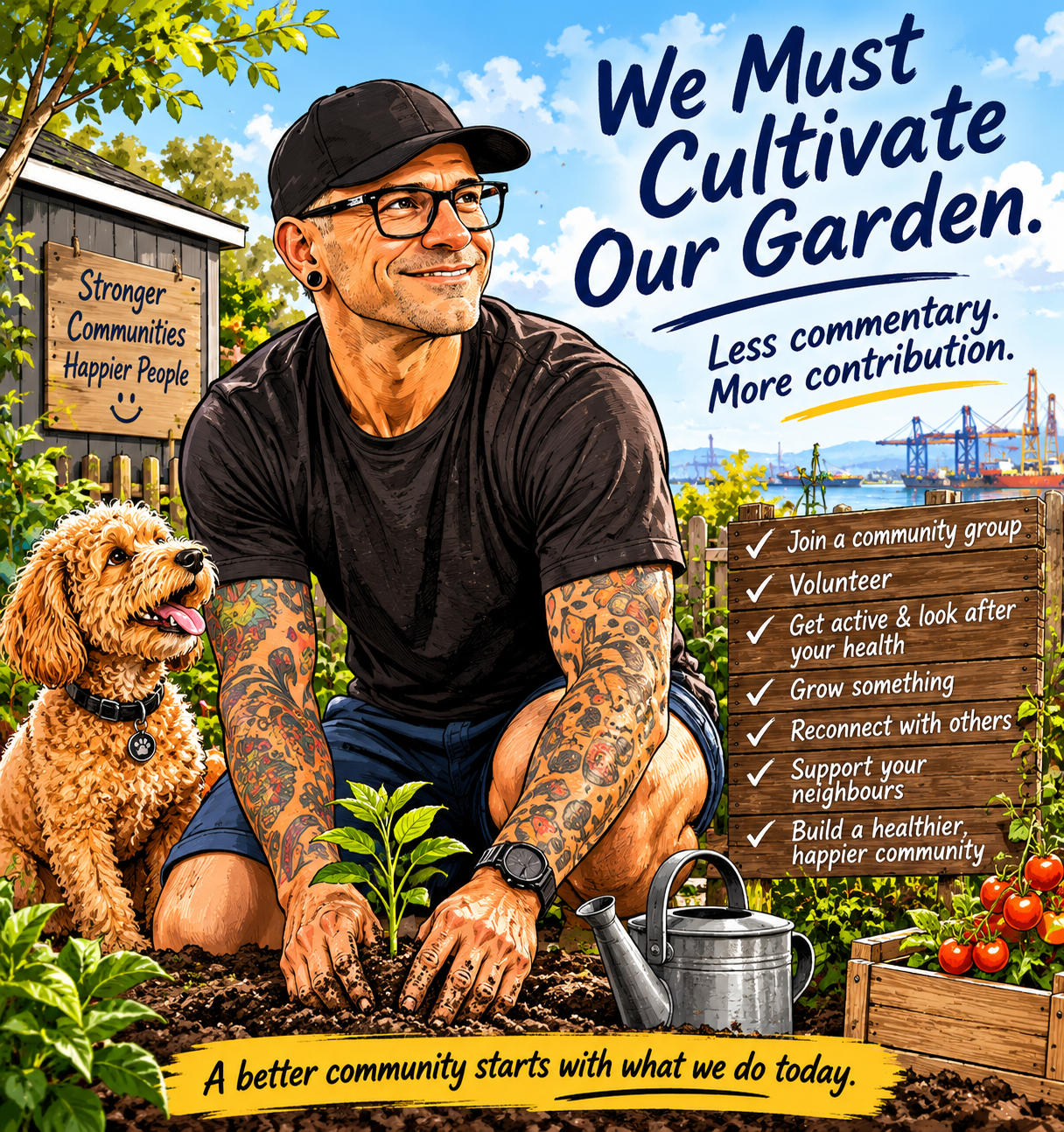
Perhaps the world doesn't need quite so many people arguing about how broken it is. Perhaps it needs a few more people getting on with making their little corner of it a better place.
There is a famous conclusion to Voltaire's 1759 philosophical novel Candide. After spending much of the story travelling through a world full of suffering, injustice, hypocrisy, disasters and seemingly endless philosophical arguments about why things happen, the characters eventually arrive at a rather simple conclusion:
"We must cultivate our garden."
It is a deceptively powerful statement.
After all the debating, theorising, complaining and trying to make sense of the grand problems of the world, the characters recognise something important. There is little value in endlessly arguing about things beyond our immediate influence while neglecting the things that are actually within our reach.
It isn't a suggestion that we should ignore injustice, stop questioning authority, abandon our values or become indifferent to the wider world.
Rather, it is a reminder that there is a difference between talking about making the world a better place and actually contributing to one.
And I wonder whether this is something we could all do with a little more of.
We've become very good at debating the world
We live in an age where we have almost unlimited access to opinions, arguments, commentary and information about everything that is supposedly going wrong.
Open your phone and within minutes you can find yourself debating politics, housing affordability, the economy, international conflict, climate change, parenting, masculinity, relationships, education, health systems and whatever controversy is currently occupying everyone's attention.
There is no shortage of people willing to tell us what is wrong, who is responsible and what somebody else needs to do about it.
Social media has made it particularly easy to become an expert commentator on the state of the world.
But how often do we step away from the screen and ask ourselves:
What am I actually doing to improve my immediate community?
When was the last time I did something useful for someone else?
Am I investing in relationships with the people around me?
Am I looking after my own physical and psychological health?
Am I contributing to something bigger than myself?
Am I spending more time complaining about disconnection than actually connecting with people?
It is possible to be incredibly informed about the problems of the world while becoming increasingly disconnected from the people and places immediately around us.
And that is worth thinking about.
Start with the patch of ground in front of you
There is something quite grounding about the idea of cultivating a garden.
You cannot make a garden grow by arguing about the weather, complaining about the soil or endlessly discussing what the gardener next door should be doing.
At some point, you have to get your hands dirty.
You have to plant something, pull out a few weeds, water the soil, give things time and pay attention to what is growing.
Our communities are not all that different.
Strong communities are built through ordinary, often unremarkable actions repeated over time. They are built through people showing up, checking in, contributing, sharing skills, helping each other and creating opportunities for people to belong.
We don't necessarily need to wait for governments, organisations or institutions to fix everything before we start doing something ourselves.
There are plenty of things we can do, right now, in our own little patch of ground.
So, what does cultivating your garden actually look like?
Here are a few practical places to start.
1. Join something. Get involved. Become part of something.
Find a local club, community organisation, sporting group, service organisation or hobby group.
It might be a fishing club, men's shed, gardening group, sporting club, book club, community choir, arts group or volunteer organisation.
It doesn't particularly matter what it is.
What matters is that you regularly turn up somewhere, alongside other people, with a shared interest or purpose.
We sometimes underestimate how important this is for our psychological wellbeing.
Belonging doesn't necessarily come from having lots of friends or being particularly sociable. Sometimes it comes from simply knowing that there is somewhere you are expected, somewhere you are recognised and somewhere you can contribute.
You don't have to be the most outgoing person in the room. Just turn up.
2. Give a little of your time to someone else
Volunteer.
Help out at a local sporting club. Get involved with a community event. Assist a charity, support a neighbourhood initiative or offer your skills to an organisation that could use them.
You don't need to save the world.
An hour or two a month can make a difference.
There is also something important that happens when we move our attention away from ourselves and towards contributing to something meaningful.
It gives us a sense of purpose, creates connection and reminds us that we have something of value to offer.
Sometimes, helping someone else is also a useful reminder that we are not as powerless as we might feel.
3. Reconnect with other men and women
We need places where men can spend time with other men and women can spend time with other women, without every interaction needing to be about work, responsibilities, parenting or getting something done.
Men's groups, women's groups, walking groups, breakfast gatherings, social clubs and informal get-togethers can provide opportunities to talk, share experiences, laugh, learn and support one another.
For men in particular, connection can sometimes be something that gets pushed to the bottom of the priority list. Work, family, financial responsibilities and the demands of everyday life take over.
We might have plenty of acquaintances but very few people we can genuinely talk to when things aren't going particularly well.
The same can happen for women, particularly when they are carrying the invisible load of family, work and caring responsibilities.
We don't always need professional intervention or a formal support service. Sometimes we need more opportunities to be around people who know us, understand us and are prepared to have an honest conversation.
Make the phone call. Organise the coffee. Get a few people together. Start the group.
4. Look after the person doing the gardening: you
We can spend an extraordinary amount of energy worrying about the world while neglecting the one thing we have a reasonable degree of influence over: ourselves.
Our physical and psychological health matter.
Start with some relatively ordinary things:
Get outside and move your body regularly.
Go for a walk, ride a bike, swim, play golf or join a sporting group.
Establish a more consistent sleep routine.
Pay attention to what you are eating and drinking.
Reduce the amount of time you spend mindlessly scrolling through your phone.
Make time for activities that give you enjoyment, satisfaction or a sense of achievement.
Seek support when you are struggling rather than waiting until things become unmanageable.
None of these things will solve every problem in your life.
But they create a better foundation from which to deal with the problems that do arise.
Sleep, movement, nutrition, social connection and meaningful activity are not luxuries. They are important parts of maintaining our psychological wellbeing.
You cannot continually neglect yourself and expect to have unlimited capacity to care for everyone and everything else.
5. Grow something. Literally.
There is something quite satisfying about growing your own produce.
A few herbs in pots, some tomatoes, a vegetable garden or a fruit tree.
You don't need acres of land or a particularly green thumb.
Plant something. Water it. Watch it grow. Eat what you produce.
Gardening gets us outside, gives us something to care for and encourages us to slow down a little.
It also provides a tangible reminder that worthwhile things take time, attention and consistency.
You cannot rush a tomato plant by arguing with it.
And perhaps there is a lesson in that for the rest of life.
6. Reinvest in your immediate relationships
Sometimes the most important patch of ground we need to cultivate is right inside our own homes.
When was the last time you sat down with your partner without a phone in your hand?
When did you last spend some uninterrupted time with your kids?
Have you checked in with your parents, siblings or an old mate?
Are there friendships that have slowly disappeared because everyone has become too busy?
We can become so caught up in the demands of everyday life that our closest relationships end up receiving whatever time and attention are left over.
Relationships need maintenance.
They need conversations, shared experiences, patience, humour, compromise and sometimes a willingness to put our own agenda aside.
A coffee with a mate, dinner with the family, a walk with your partner or a phone call to someone you haven't spoken to in months might not seem particularly significant.
But these are the things that make up a life.
7. Make your street, workplace and neighbourhood a little better
Cultivating your garden doesn't have to be a private exercise.
It can be as simple as getting to know your neighbours, picking up rubbish when you see it, supporting local businesses, welcoming someone new to the area or offering a hand when someone needs it.
At work, it might mean making an effort to include someone who is regularly left out, recognising a colleague's efforts, having a conversation with someone who seems to be struggling or being the person who helps create a healthier workplace culture.
These small actions matter because culture isn't just something created by management, government or organisational policies.
It is also created by the everyday behaviours of the people who make up those environments.
We all contribute something to the atmosphere around us.
The question is whether we are contributing to something that makes life better or simply adding to the noise.
This isn't about giving up on the bigger picture
I want to be clear about something.
There are genuine systemic problems that require collective action, advocacy, political engagement, policy reform and institutional accountability.
We shouldn't use the idea of cultivating our own garden as an excuse to ignore injustice or avoid difficult conversations.
Sometimes we absolutely need to challenge the bigger systems.
But perhaps we need to be a little more conscious of where we direct our energy.
There is a difference between constructive engagement and endless argument.
There is a difference between being informed and being consumed.
There is a difference between advocating for change and spending hours becoming increasingly frustrated about things we have little immediate ability to influence.
We can care about the wider world while also taking responsibility for the small part of it that we inhabit.
In fact, perhaps that is where meaningful change starts.
Communities don't become healthier simply because enough people agree that things need to improve.
They become healthier when people start doing things differently.
A little less commentary. A little more contribution.
Imagine if, instead of spending another evening arguing with strangers online, we used that time to get outside, go for a walk, prepare a decent meal, tend to a garden or call a friend.
Imagine if more people joined a local club, volunteered a few hours, organised a regular men's or women's gathering, supported a neighbour or became involved in something that made their community a better place to live.
Imagine if we spent a little less time talking about how disconnected society has become and a little more time actually connecting with one another.
It wouldn't fix everything.
But it might make a meaningful difference to the quality of our everyday lives.
And perhaps that is the point.
We don't have to solve every problem in the world before we can start making our little corner of it a better place.
We don't have to wait for someone else to organise it, lead it, fund it or fix it.
We can start with ourselves, our families, our friendships, our workplaces and our communities.
We can plant something. Join something. Help someone. Learn something. Reconnect with someone.
We can get outside, put the phone down and start participating in the world rather than simply commenting on it.
Perhaps it's time we spent a little less time debating the state of the world and a little more time cultivating our gardens.
After all, the patch of ground in front of you is the one you can actually do something about.
